Sexten and its roots
The history of mountaineering, war and tourism.
Sexten looks back on a long and eventful history. Three major chapters, however, have become firmly embedded in the DNA of the village and continue to shape its identity to this day: the history of mountaineering, which made Sexten a renowned mountaineering village; the harrowing period on the front line during the First World War; and the steady development into a modern holiday destination since the mid-20th century. Various interactive exhibitions, themed trails and museums tell the story of Sexten and raise awareness of the issues of the time.
- The Alpine history of Sexten begins with the legendary first ascents between 1869 and 1890 – and the story is far from over. New records continue to be set. While the initial focus was on simply reaching the summit, attention soon shifted to speed and technique. Over more than 150 years, the focus has repeatedly been on the impossible, the unimaginable. New, more challenging routes were planned, turning the Dolomites into a playground for technique and creativity. In the 1930s, the Schranzhofer brothers from Sexten caused international sensation with the 6th grade of difficulty. The 1950s brought extreme Direttissima routes using pitons, and in 1968 everything culminated in the ascent of the 40-metre overhanging rock roof of the West Peak – and today the challenge is called “Free Solo”.
- As a village on the war front between Austria-Hungary and Italy, Sexten and its mountains became a direct theatre of the First World War. The village lay in ruins, families were torn apart, and soldiers fought at icy altitudes. To this day, numerous relics in the mountains bear witness to this dark chapter. The ONLUS association Bellum Aquilarum is dedicated to processing this history and making it tangible – for example in the open-air museum in the area of “Anderter Alpe” on the Rotwand, where original positions and trenches have been preserved. The permanent exhibition “Unvergessen”, unforgotten, in the village centre tells of life on the mountain front, of the battles at Sentinellapass, Rotwand and Elfer – and of flight, return to nothingness and the complete reconstruction of a village.
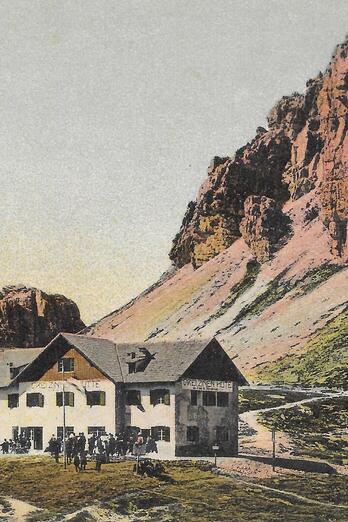
- Without a doubt, it is the impressive Dolomites scenery that has shaped Sexten into what it is today: a popular destination for active holidaymakers and lovers of panoramic views. In summer, the peaks of the Sexten Dolomites and Alpine pastures attract visitors; in winter, the Three Peaks ski area and an extensive network of cross-country trails. The mountain farming village became a mountaineering village and ultimately a modern holiday destination – closely linked to the history of alpinism. The first guests in the village were well-travelled pioneers and summit seekers looking for guided ascents with full service. Some skilled climbers from Sexten soon made a name for themselves and invested their guiding earnings in the construction of the first hotels. Thus, the rugged world of the Dolomites became accessible to many. New accommodation, ski lifts and a ski school were built in the valley to make Sexten attractive in winter as well.

Made in Sexten
Which products and specialities are made in Sexten?